
Members have paid you for care you have not yet delivered. Here is how that money is treated at closing, with numbers you can adapt
Concierge and direct primary care practices share a feature that most other businesses do not: members often pay months of fees in advance. That cash is wonderful for operations, but it creates a question at closing that surprises many physicians. If your members have prepaid for care that the practice has not yet provided, and a buyer is about to take over the obligation to provide it, who keeps the money?
The honest answer is that concierge practice prepaid memberships are usually treated as an obligation that moves with the business, and buyers will want to be credited for it. This article explains why, walks through a simple worked example and shows how timing alone can change the number by six figures. The figures are hypothetical, so adapt them to your own practice.
Why Concierge Practice Prepaid Memberships Matter in a Sale
Accountants often describe the cash from concierge practice prepaid memberships as deferred or unearned revenue. You have received cash, but you earn it month by month as you deliver care. If you sell the practice halfway through a member’s year, you hold cash for six months of service that the buyer will now have to deliver.
From the buyer’s point of view, taking on that obligation without receiving the money would be like paying for a business and then funding a debt you left behind. So most buyers either reduce the price by the unearned amount, require a cash transfer at closing or build it into a working capital adjustment. Our guide to adjusted EBITDA in a medical practice sale shows how buyers examine earnings, and deferred revenue is a related but separate question that affects what you actually take home.
The Practice in Our Example
Let us imagine a small concierge practice with these characteristics:
- 300 active members
- 180 members pay an annual fee of $1,800 up front, on their own renewal dates
- 120 members pay $150 per month and have no prepaid balance
- Closing is planned for a single date
The 120 monthly members create no issue, because each month’s fee matches the month’s care. The 180 annual members are where the question arises.
Step One: Total the Annual Billings
The practice collects 180 members × $1,800 = $324,000 per year in annual fees. That figure is not unearned at any one moment. It becomes unearned in pieces as renewals arrive.
Step Two: Estimate the Unearned Portion at Closing
If annual renewals are spread evenly across the year, an average member has used about half of the period at any given time. The unearned portion would be roughly half of $324,000, or $162,000.
So in the simplest case, the practice would hold about $162,000 in cash that relates to care a buyer will provide after closing.
Step Three: See How Timing Changes the Answer
Real practices are rarely perfectly even. Many renew in January or around the start of a school year. Suppose that half of the annual members, 90 people, renew in January, while the other 90 are spread evenly through the year. Look at what happens with different closing dates.
| Closing date | Unearned on January renewals | Unearned on evenly spread renewals | Total unearned |
|---|---|---|---|
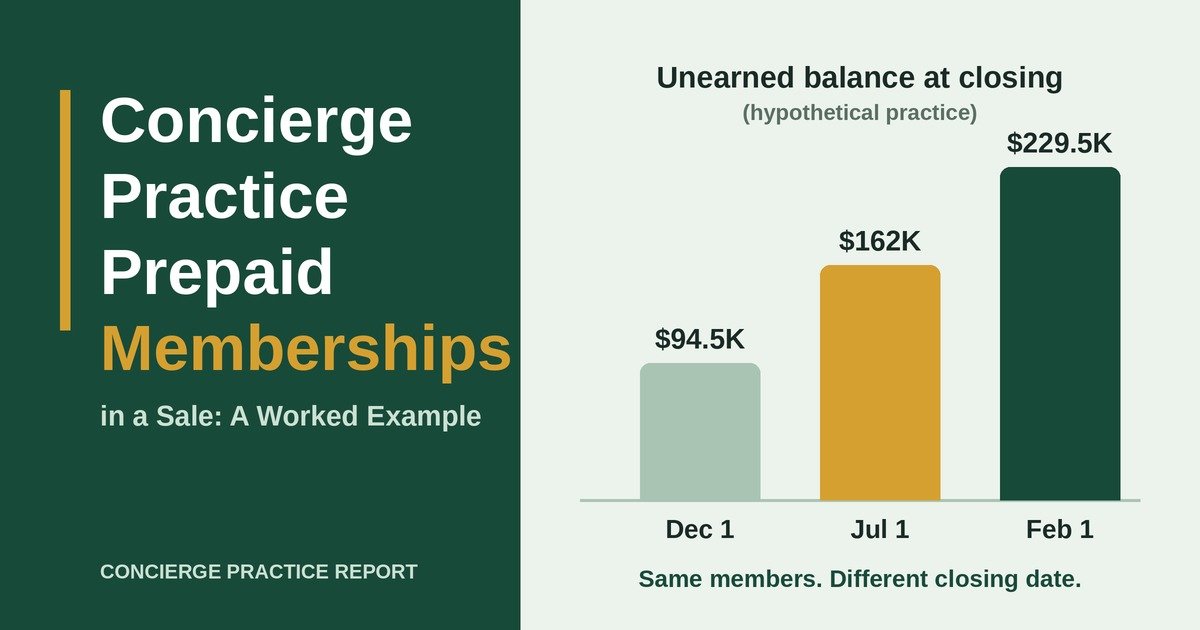
| December 1 | $13,500 (1 month left) | $81,000 | $94,500 |
| July 1 | $81,000 (6 months left) | $81,000 | $162,000 |
| February 1 | $148,500 (11 months left) | $81,000 | $229,500 |
The calculation for January renewals is 90 members × $1,800 × the share of the year remaining. For example, with 11 months left, that is 90 × $1,800 × 11/12 = $148,500. The even group stays at 90 × $1,800 × 0.5 = $81,000 in each scenario.
The lesson is striking. The same practice, with the same members, would transfer between about $94,500 and $229,500 in unearned obligations depending only on the closing date. Moving closing by two months can shift tens of thousands of dollars in either direction. That is why it pays to understand your renewal pattern before you agree a closing date in a letter of intent.
Step Four: Decide How the Number Is Handled
There are several common ways to settle the balance, and each affects who bears risk.
- Price reduction. The buyer deducts the unearned amount from the purchase price. This is simple, and the seller keeps the cash already collected.
- Cash transfer at closing. The seller transfers the unearned cash to the practice, in effect leaving it behind. Mathematically it is similar to a deduction.
- Working capital adjustment. The deferred balance is one of several items in a target-based calculation, adjusted after closing. This can include a true-up once actual figures are known.
- Escrow or holdback. Part of the price is held to cover potential refunds or disputes.
Whichever method is used, read the definition of the number carefully. Disputes often arise over how it is calculated, which date is used and whether monthly payers or partial refunds are included.
Questions About Refunds and Member Choice
The numbers above assume that members stay. Real life adds two complications.
Refund rights. Membership agreements, and in some places state rules, may give members rights to a refund of unused fees under certain conditions, such as if you leave the practice or if services end. Review your own agreement and check state requirements with your attorney. A buyer will want to know how much exposure exists and whether the agreement allows members to leave and claim a refund after an ownership change.
Member choice. Some members join because of a particular physician. If you are leaving, some may choose to leave too. The more your members depend on you personally, the more a buyer will worry about attrition, and the more they will want the unearned balance and any refund risk addressed. Our article on transitioning out of a concierge practice explains how owners approach this, and our guide on associate buy-ins describes an internal route that often preserves continuity.
Communicating With Members
How you tell members matters as much as the numbers. A thoughtful approach usually includes:
- Telling members personally, not through a notice, wherever possible
- Explaining what stays the same, such as care team, access and fees
- Describing how the transition will work and who will be their physician
- Being clear about their rights under the membership agreement
- Timing the message so they hear it from you before they hear it elsewhere
Buyers often want to see the planned message before it goes out, and some want it to be coordinated with the closing date. Be careful about confidentiality until the right time; our guide to how to sell a concierge medicine practice explains the stages in which information is usually shared.
Mixed Billing Models Change the Math
Many practices sell concierge practice prepaid memberships in more than one billing model, and each model behaves differently at closing. A quick comparison shows why you should know your own mix:
- Annual prepayment can leave a large unearned balance that depends on renewal dates. Buyers focus on its size and on refund rights.
- Quarterly prepayment leaves a smaller balance, limited to the current quarter. Buyers focus on the timing of the last billing run.
- Monthly billing usually leaves almost nothing to adjust. Buyers focus on payment reliability and member retention.
- Corporate or employer contracts vary with the contract terms. Buyers focus on renewal dates and change-of-control clauses.
A practice that is mostly monthly has little to adjust but may face more questions about retention. A practice that is mostly annual has a bigger adjustment but often stronger cash flow before the sale. Neither is better in itself, but you should know which one you are, because it shapes both the closing date you prefer and the way you negotiate.
Common Mistakes to Avoid
- Treating collected cash as profit. Prepaid fees from concierge practice prepaid memberships look like income but are partly an obligation. Counting them as earned inflates your numbers and invites a correction during review.
- Ignoring the renewal calendar. As the example shows, closing right after a heavy renewal month produces a much larger balance than closing just before it.
- Skipping the agreement review. Refund terms and assignment clauses may limit your choices, and discovering that late weakens your position.
- Waiting to tell your accountant. Revenue recognition matters here, so bring your accountant into the planning early.
What to Prepare Before You Go to Market
Take these steps well before a buyer asks:
- Build a member ledger. List each member, fee, payment frequency, renewal date and amount prepaid.
- Calculate unearned revenue by month. Show what the balance on your concierge practice prepaid memberships would be at the end of each month.
- Review your membership agreement. Check how it treats concierge practice prepaid memberships, and note refund, termination and assignment provisions.
- Check your accounting method. Confirm how deferred revenue is recorded, and whether your reports match your bank records.
- Prepare for a financial review. A quality of earnings review will test these numbers, so it helps to have them clean.
Where Advisors Fit
Because the treatment of concierge practice prepaid memberships affects both price and timing, it is worth modeling before you sign a letter of intent. Advisors who specialize in healthcare transactions can help you test closing dates and compare how different buyers handle the issue. Olympic M&A, for instance, lists concierge medicine among its specialized sectors. Bring your attorney and accountant into the discussion early, since both will be central to how the final terms are written.
Key Takeaways on Concierge Practice Prepaid Memberships
Concierge practice prepaid memberships are an asset in daily life and an obligation in a sale. Expect buyers to account for them, and expect the number to vary with your renewal pattern and closing date. A simple member ledger, a month-by-month estimate and a read of your agreement will put you in a much stronger negotiating position. For a broader view of how buyers think, read about the concierge practice buyers active today and how they assess what a concierge practice is worth.
All figures in this article are hypothetical and for illustration only. This article is general information and not legal, tax or accounting advice. Membership and refund rules vary by state and by agreement. Consult qualified professionals about your practice.
About Concierge Practice Report
Concierge Practice Report publishes practical, owner-focused guidance for people planning a sale or transition. Visit conciergepracticereport.com for more guides.